ATM Exam Preparation Material | ISTQB Certified Tester Advanced Level - Test Manager [Syllabus 2012]

Prepare for the ATM with reliable study materials, practice questions, and key exam insights.

Prepare for the ATM ISTQB Certified Tester Advanced Level - Test Manager [Syllabus 2012] exam with CertQueen's independently developed study resources. Review important concepts, practice scenario-based questions, and use clear explanations to identify areas that require further study.

Question#1

Assume that you are the Test Manager for a small insurance application development project.
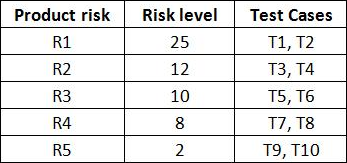
You have decided to adopt a risk-based testing strategy: 5 product risks (R1, R2, R3, R4, R5) have been identified and their levels of risk have been assessed. 10 test cases (T1, …, T10) have been designed to cover all the product risks.
The following table shows the risk level and the test cases associated to the identified product risks (higher risk level means higher risk):
You are not confident with the assessment of the risk level and you suspect that it will be possible to find high-priority bugs in low-risk areas.
ISTQB-ATM9_1

Furthermore the period for test execution is very short. Your goal is to test all the product risks in a risk-based way, while assuring that each product risk gets at least some amount of testing.
Which answer below describes the best test execution schedule for this scenario? K3 2 credits

A. T1, T2, T3, T4, T5, T6, T7, T8, T9, T10
B. T1, T3, T5, T7, T9, T2, T4, T6, T8, T10
C. T10, T9, T8, T7, T6, T5, T4, T3, T2, T1
D. T10, T8, T6, T4, T2, T9, T7, T5, T3, T1

Question#2

During the follow-up phase the following conditions are checked:
X1. The code has been completely reviewed
X2. All the identified defects have been correctly fixed and the modified code has been compiled successfully and run through all the static analyzers used by the project without warnings and errors
X3. The modified code is available under the configuration management system with a new version number for the specified CI
If these conditions are fulfilled then the review process terminates.
Which characteristic of a formal review is absent from this description? K2 1 credit

A. Defined entry and exit criteria
B. Checklists to be used by the reviewers
C. Deliverables such as reports, evaluation sheets or other review summary sheets
D. Metrics for reporting on the review effectiveness, efficiency, and progress

Question#3

Assume that you are the Test Manager for a small banking application development project.
You have decided to adopt a risk-based testing strategy and 5 product risks (R1, R2, R3, R4, and R5) have been identified during the quality risk analysis.
The following table shows the risk level associated to these product risks (higher numbers mean higher risk):

ISTQB-ATM7_1

55 test cases have been designed and implemented to cover all these 5 product risks. The coverage is described in a traceability matrix.
This is the test execution status table, after the after the first week of test execution:
About 56% of the planned test cases have been successfully executed.
Assume that no additional product risks have been identified during the first week of test execution.

ISTQB-ATM7_2

At the end of the first week of test execution, which answer below would you expect to best describe the residual risks associated with the identified product risks? K3 2 credits

A. Because R3 is the only risk whose test cases have all passed, the risk has been reduced by 20%
B. According to the test execution status table, the risk has been reduced by 56%
C. It is not possible to determine the residual risk level because all test cases must have been executed to do so
D. The test execution table gives no indication of the risk level of open defects and test cases that have failed or have not yet run

Question#4

Assume you are the Test Manager for a new software release of an e-commerce application.
The server farm consists of six servers providing different capabilities. Each capability is provided through a set of web services.
The requirements specification document contains several SLAs
(Service Level Agreements) like the following:
SLA-001: 99.5 percent of all transactions shall have a response time less than five seconds under a load of up-to 5000 concurrent users
The main objective is to assure that all the SLAs specified in the requirements specification document will be met before system release. You decide to apply a risk-based testing strategy and an early risk analysis confirms that performance is high risk. You can count on a well-written requirements specification and on a model of the system behavior under various load levels produced by the system architect.
To achieve the test objectives in this scenario, which of the following test activities would you expect to be the less important ones?
K4 3 credits

A. Conduct unit performance testing for each single web service
B. After the system is released into the production environment, monitor the SLAs
C. Conduct system performance testing consisting of several performance testing sessions to verify whether all the SLAs have been met
D. Conduct static performance testing by reviewing the system's architectural model under various load levels

Question#5

Assume you are working on a CAS (Conditional Access System) for Pay-TV that allows the access, selection and transfer of services and media to authorized users. Authorized users can choose their services through different channels: Web Customer Portal, IVR (Interactive Voice Response), Call Centre and SMS. The system uses a Smart Card to receive and decrypt the broadcasted encrypted control words which allow decrypting pay-per-view TV. Every authorized user must have a Smart Card and a Set-Top Box to view the contents.
The following is an excerpt from the product risk analysis document:
Both likelihood and impact have been rated on the following scale: (1 C Very low, 2 C Low, 3 C Medium, 4 C High, 5 C Very High).
The required test environment and code have been delivered. All test cases for each
identified product risk item have been written and are ready to be executed. The Database used to contain the Smart Cards is empty and so only new Smart Cards can be used during test execution.
A Smart Card can only be activated if it has been previously pre-activated. This means the post-conditions for the execution of the test cases to test the pre-activation of the Smart Card are the pre-conditions for activation of the Smart Card.
Which statement below represents the stakeholders' most effective contribution to completing the failure mode analysis table?

ISTQB-ATM5_1

K4 3 credits

A. To assess the detection, the aircraft pilot and the customer representative should contribute. To assess the priority, the chief software engineer, the system architect and the expert tester should contribute.
B. To assess the priority, the aircraft pilot and the customer representative should contribute. To assess the detection, the chief software engineer, the system architect and the expert tester should contribute.
C. The system architect and the chief software engineer should help assess the priority. Only the expert tester should contribute to assess the detection.
D. Only the aircraft pilot is qualified to help assess the priority and thus should be assigned this task. The customer representative should help assess the detection.

Exam Code: ATM
Q & A: 64 Q&As         Updated:  Oct 31,2026


 Access Complete ATM Preparation Material

What This ATM Study Resource Helps You Do

Review Key Concepts

Review the technologies, products, processes, and practical skills covered by the current ATM exam objectives.

Practice Scenario-Based Questions

Work through independently developed questions designed to strengthen your understanding of technical scenarios and decision-making.

Identify Knowledge Gaps

Use your results and the provided explanations to find weaker areas and focus your study more effectively.

How to Use This ATM Preparation Material

Review the Exam Scope

Start by reviewing the topics covered by the ATM exam. Compare them with the official exam objectives to understand the required technologies, operational tasks, and practical skills, then identify the areas that deserve the most attention.

Practice Independently

Complete a focused set of practice questions for each topic. On your first attempt, avoid referring to notes, answers, or other study resources so that you can evaluate your current understanding more accurately.

Study the Explanations

Review the answers and explanations after completing each practice session. Understand why the correct option is appropriate for the given scenario and why the other options may be incorrect or less suitable.

Close Knowledge Gaps

Keep track of incorrect answers, unfamiliar concepts, and weaker knowledge areas. Review these topics using official documentation and practical experience, then answer the related questions again to reinforce your understanding and monitor your progress.

Independent ATM Preparation Resource

CertQueen independently develops its certification study materials for educational purposes. The practice questions are not copied from, recalled from, or presented as live or official exam questions.

CertQueen is not affiliated with, endorsed by, sponsored by, or authorized by any certification provider. Certification names, exam codes, product names, and related trademarks are the property of their respective owners and are referenced only for identification and educational purposes.
