

CCAR-F vs CCA-F: Claude Certified Architect Foundations Exam Code Clarified
Candidates preparing for the Claude Certified Architect - Foundations certification may encounter two similar labels: CCAR-F and CCA-F. The difference can cause unnecessary confusion, particularly when comparing exam guides, community discussions, course titles, and study resources.
The clarification is straightforward. CCAR-F is the official exam code for Claude Certified Architect - Foundations. CCA-F is an informal abbreviation that may appear in community-created content. They refer to the same Foundations certification rather than two separate exams.
CCAR-F is the official exam code
The Claude Certified Architect - Foundations Exam Guide, Version 1.0 effective July 2026, identifies the exam as CCAR-F.
Candidates should use CCAR-F when reviewing official exam information, checking the current blueprint, or looking for registration details. This is the code tied to the Foundations credential and its published exam requirements.
The official name of the credential is Claude Certified Architect - Foundations. The exam code uses the letters "CCAR" to identify the Certified Architect credential and the letter "F" to identify the Foundations level.
Why CCA-F appears in study discussions
CCA-F is a natural shorthand for Claude Certified Architect - Foundations, so it has appeared in community posts, informal course descriptions, and older study discussions. The abbreviation does not identify a different certification.
There is no indication that CCA-F is a previous version of the exam, a separate entry-level certificate, or an alternative test with different requirements. It is simply a shorter label that some learners use when discussing the Foundations exam.
| Item | CCAR-F | CCA-F |
|---|---|---|
| Status | Official exam code | Informal community abbreviation |
| Credential | Claude Certified Architect - Foundations | Claude Certified Architect - Foundations |
| Main use | Official exam details and registration | Community discussion and study content |
| Exam version | Foundations exam | Not a separate or retired exam |
| Recommended use | Use for official references | Recognize as a shorthand only |
For candidates, the practical takeaway is simple: use CCAR-F as the primary search term and check that study materials match the current exam guide.
What the CCAR-F exam measures
Claude Certified Architect - Foundations is intended for practitioners who design and implement production applications using Claude. The certification focuses on architecture choices rather than basic product familiarity alone.
Candidates are expected to make informed tradeoffs when designing solutions. The exam includes agentic systems, tool design, Model Context Protocol integration, Claude Code workflows, prompt engineering, structured output, context management, and reliability.
The intended audience includes solution architects and technical professionals who work with Claude APIs, the Agent SDK, Claude Code, and MCP. The exam guide describes a candidate with practical experience applying these tools in production-oriented solution design.
CCAR-F exam format and scoring
The Foundations exam uses a proctored format and combines standard questions with scenario-based assessment. Candidates should understand the format before beginning their preparation plan.
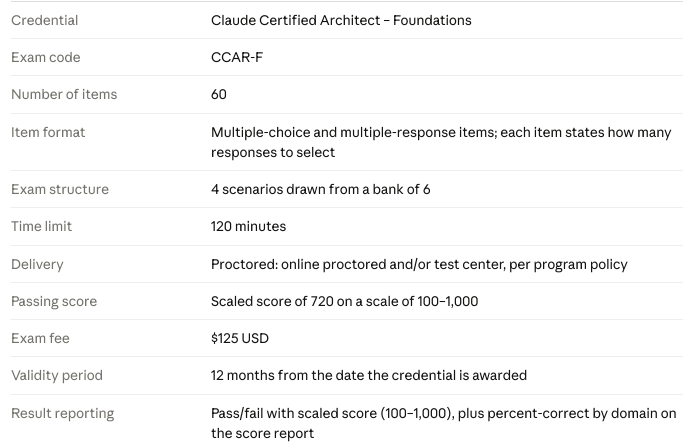
The scaled passing score is worth noting. A score of 720 does not mean candidates need exactly 72 percent of questions correct. Scaled scores are not direct percentages, so preparation should focus on consistent understanding across the exam domains rather than trying to calculate a target number of correct answers.
Five domains in the Foundations blueprint
The CCAR-F blueprint is divided into five weighted domains. Agentic Architecture and Orchestration has the largest share of the exam, followed by Claude Code Configuration and Workflows and Prompt Engineering and Structured Output.
| Exam domain | Weighting |
|---|---|
| Agentic Architecture and Orchestration | 27% |
| Tool Design and MCP Integration | 18% |
| Claude Code Configuration and Workflows | 20% |
| Prompt Engineering and Structured Output | 20% |
| Context Management and Reliability | 15% |
This structure gives candidates a useful way to organize revision.
Agentic Architecture and Orchestration covers the design decisions behind systems that use agents and coordinated workflows. Tool Design and MCP Integration focuses on connecting Claude-based applications to external tools and services through well-designed integrations.
Claude Code Configuration and Workflows examines practical ways to configure and use Claude Code in development work. Prompt Engineering and Structured Output covers techniques for producing reliable, structured responses that fit an application's requirements.
Context Management and Reliability addresses a major part of building production applications. Candidates need to consider how context is selected, maintained, and managed so that the system can deliver dependable results.
Scenario-based coverage
The exam guide describes six possible scenarios, with four selected for a given exam. These scenarios include customer support resolution, code generation with Claude Code, multi-agent research, developer productivity, Claude Code CI/CD workflows, and structured data extraction.
This means candidates should prepare to apply concepts to practical design situations. Memorizing terminology alone may not be enough. A study plan should connect each blueprint area to the kind of architecture decision that could arise in a real application.
For example, a candidate may need to understand when an agent needs a tool, how structured output supports downstream systems, or how context choices can affect reliability. The exam assesses the ability to reason through these kinds of decisions within the stated exam domains.
CCAR-F and CCAR-P are different credentials
Another point of confusion is the relationship between CCAR-F and CCAR-P. CCAR-F is the Foundations-level Claude Certified Architect exam. CCAR-P is a separate Professional-level credential with its own exam guide and blueprint.
Candidates should not assume that content created for CCAR-P will fully match the Foundations exam. The professional certification has different scope and expectations. Before choosing a preparation resource, candidates should confirm that it specifically identifies CCAR-F and follows the Foundations-level domains.
How to review materials that use CCA-F
Study resources that use CCA-F are not automatically incorrect. The abbreviation usually points to the same Claude Certified Architect - Foundations exam. However, candidates should check the actual content instead of relying only on the title.
A useful review checklist includes:
●Does the resource identify the credential as Claude Certified Architect - Foundations?
●Does it use the CCAR-F exam code or clearly state that CCA-F is an informal shorthand?
●Does it cover the five current blueprint domains?
●Does it include agentic architecture, MCP integration, Claude Code, structured output, context management, and reliability?
●Does it distinguish the Foundations exam from CCAR-P?
If the answers are clear, the resource may still be relevant even if it uses the informal abbreviation. If the exam name, code, or domain structure does not match, candidates should compare it with the current CCAR-F guide before relying on it.
CCAR-F is the official code for the Claude Certified Architect - Foundations exam. CCA-F is an informal abbreviation used in some community content for the same credential.
Candidates should use CCAR-F for official references and verify that their learning materials align with the current 60-item, 120-minute Foundations exam and its five weighted domains.
- Related Suggestion
- CCAO-F vs CCAR-F vs CCDV-F vs CCAR-P: Compare Anthropic Claude Certifications July 22,2026